

Contribution Margin
This article aims to clarify how to use the Contribution Margin Calculation.
What is Contribution Margin
Section titled “What is Contribution Margin”In a simplified way, the Contribution Margin is the amount of money left over after removing variable expenses and variable expenses.
The Contribution Margin shows the difference between the product’s sales, costs and expenses. It represents the percentage that the value of sales contributes to the payment of fixed expenses.
Calculating the contribution margin helps to identify what part of the resources generated are necessary to pay expenses and still have cash on hand.
Frequently asked questions
Section titled “Frequently asked questions”Configuring the Contribution Margin
Section titled “Configuring the Contribution Margin”- In the Order Type settings, you must select one of the options in the “Contribution Margin Behavior” field.

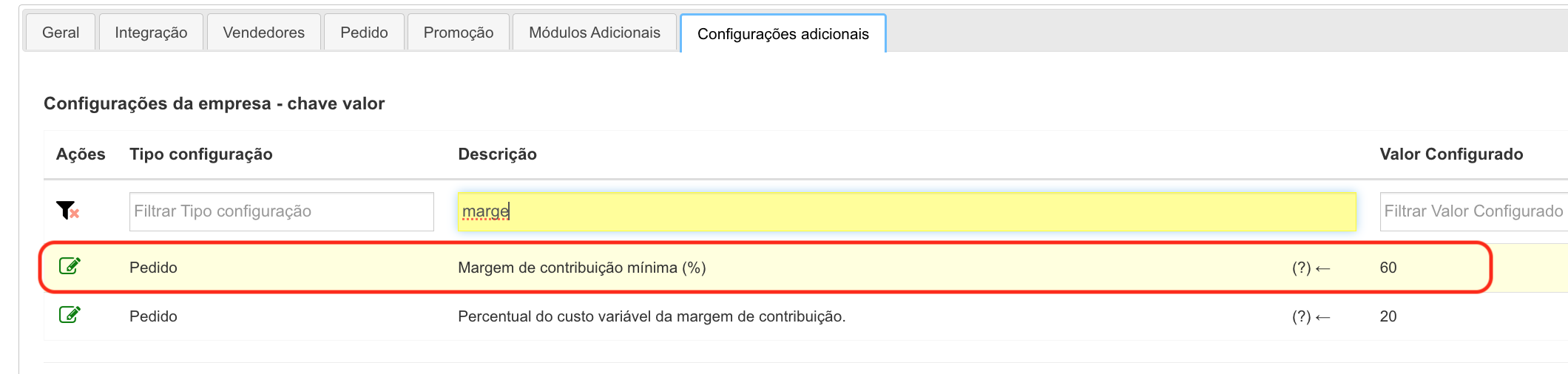
- Setting the minimum value of the contribution margin is done in Company Settings, “Additional settings” tab, in the “Minimum contribution margin (%)” setting.
- Here the minimum % of the contribution margin is placed.
- For margin blocking, this is the base value, when it falls below the specified value, the order is blocked.
- Here the minimum % of the contribution margin is placed.
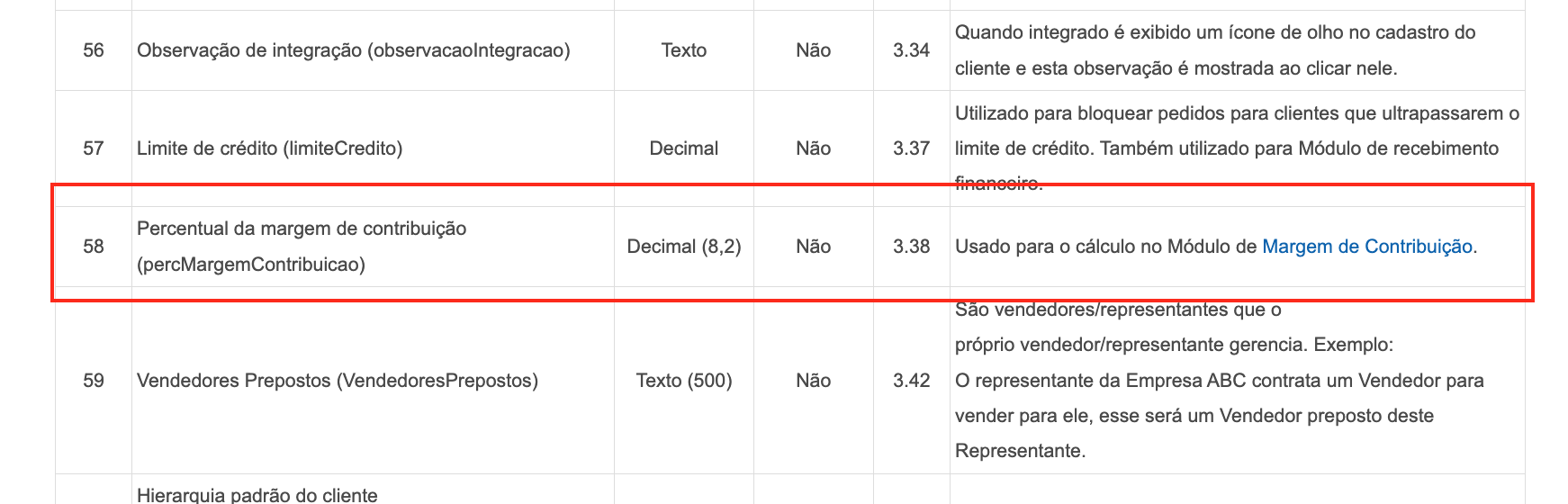
- This configuration also exists on the Client (only by integration Field 58 of Table 18 - Clients). For Customers who have the minimum % of contribution margin, the customer’s minimum margin will be respected.
- The contribution margin is calculated based on a few different variables:
- Payment method: % interest or additions. “Payment Methods” screen, “Order Settings” tab
- Payment terms: % interest or additions. “Payment Conditions” screen, “Configuration” tab
- Commercial agreement: % registered with the client. “Customers” screen, “Financial” tab
- Replacement cost: Cost of replacing the product. “Product Prices” screen.
- Variable cost: % more that will be considered in the calculation. “Company Settings” screen, “Additional Settings” tab.
- Discount Type: % Variable cost. Interest or Additions. “Discount Type” screen.
- Variable cost: % more that will be considered in the calculation. “Order Type” screen in the “Configuration” tab.
- Variable cost: % more that will be considered in the calculation. “Shipping Type” screen.
Configuring in the Release Hierarchy
Section titled “Configuring in the Release Hierarchy”- It is not necessary to configure a release hierarchy to view and validate the contribution margin.
- If you want to block orders that exceed the minimum value defined for contribution margin by your company, you can use contribution margin with the release hierarchy. To do this, it is necessary to configure a “Release Hierarchy”.
- For detailed guidance on how to configure your release hierarchy, follow the steps outlined in the article “Order Release Hierarchy”.
Calculating Contribution Margin
To make it easier to understand the Contribution Margin, watch the video below. After the video, the spreadsheet used in the demonstration can be downloaded to simulate the calculations with the data relevant to your company.
>> Download the spreadsheet to simulate the calculations <<
Example of calculations
Section titled “Example of calculations”As an example, let’s imagine the following scenario, where the contribution margin is calculated only based on the cost of the product.
- Cost of products: R$2,000.00, Sales value R$3,000.00, Customer/Company with contribution margin limit of 40%.
- The calculation is (3000-2000)/3000*100 = 33.33333%
Now the same scenario, but considering payment method, payment condition, commercial agreement and variable cost.
- Cost of products: R$2,000.00, Sales value R$3,000.00, Payment method with 5% interest, Payment terms with 5% interest, Commercial agreement at 10% and Variable cost at 20%, Customer/Company with contribution margin limit at 40%
- The calculation is (3000-2000-600)/3000*100 = 13.33333% (The value of R$600.00 in this calculation refers to the value of the variable cost where (3000*20)/100))Published on April 11, 2014 GILLES B. DE PAULA
Average reading time
Contribution Margin is an economic-financial indicator capable of saying exactly whether a company’s revenue is sufficient to pay the costs and fixed expensesand still make a profit. This is fundamental information, especially because sales volume is not synonymous with profitability.
Considering this, calculating the contribution margin is one of the most important attitudes for a company, and needs to be done regularly. However, although it is quite crucial and indispensable for the formation of the sale price and the analysis of the financial conditions of a business, the calculation is quite simple.
In this article, you will learn, in detail, how to find the contribution margin, find out the information you need to have on hand to define it properly and understand how to use it to develop your business. Check it out!
What you will find in this article:
No time to read right now?
Section titled “No time to read right now?”Download the PDF file
(and take the opportunity to send it to your colleagues)
What is contribution margin
Section titled “What is contribution margin”Also known as gross profit,the contribution margin represents how much the profit from the sale of each product will contribute to the company covering all its costs and expenses—called structure cost—and still generating profit. Based on this, you can calculate the minimum quantity of products you will need to sell to avoid losing money.
To find this indicator, just follow the contribution margin formula, which is the value of sales, minus the value of variable costs and expenses: Contribution Margin = Sales Value – (Variable Costs + Variable Expenses)